Build your prayer room in an afternoon.
You do not need a spare room, a renovation budget, or a house you own. You need one place that is decided in advance, so that showing up stops requiring a fresh decision every time.
Why a place at all?
Jesus said: go into your room and shut the door. He was not prescribing architecture — He was contrasting private prayer with performance. But there is a practical wisdom in it that anyone who has tried to pray "wherever" eventually discovers: a decided place removes one decision from a moment when you have very little willpower left. The door is the point. Whatever functions as a door for you will work.
But when you pray, go into your room and shut the door and pray to your Father who is in secret. And your Father who sees in secret will reward you.
Matthew 6:6 (WEB)Five spaces that actually work
The closet
What you need: A cleared floor, a cushion or folded blanket, a small light, and wall space for cards.
- Empty enough of it that you can sit or kneel without moving anything.
- Add light — a clip lamp, a battery puck, or a string of warm bulbs.
- Put a cushion on the floor. Comfort is not unspiritual; a numb leg ends prayers.
- Put your first three cards on the wall at eye level from where you sit.
The corner
What you need: A chair that is used for nothing else, a small table or stool, a lamp.
- Choose a chair nobody sits in casually, facing away from screens and doors.
- Put a small table beside it: Bible, notebook, pen. Nothing else.
- Add a lamp so the corner works before sunrise.
- Pin or lean your cards where you look when you sit down.
The car
What you need: A parked car and fifteen minutes before you go inside.
- Pick the moment: the company lot before your shift, or your driveway before you walk in.
- Keep an index card in the visor with three names on it.
- Turn the radio off. Say it out loud — you are alone and nobody can hear you.
- Do not skip it because it is not a room. It has a door, and that is the requirement.
The desk
What you need: Ten minutes, a drawer, and one card you can stand up.
- Choose a fixed time — first thing, or the ten minutes after lunch.
- Keep one card in the drawer and stand it up when you begin.
- Put your phone face down, out of reach, for those ten minutes.
- End by writing one line in a notebook so tomorrow has somewhere to start.
The shared home
What you need: A bag, a time, and a household agreement.
- If you have no private square metre, make a portable kit: notebook, cards, pen, in one bag.
- Agree with your household on a time — twenty minutes that everyone knows is yours.
- Use the bathroom, the balcony, the stairwell, or the parked car without embarrassment.
- Susanna Wesley pulled her apron over her head with children in the room. It counted.
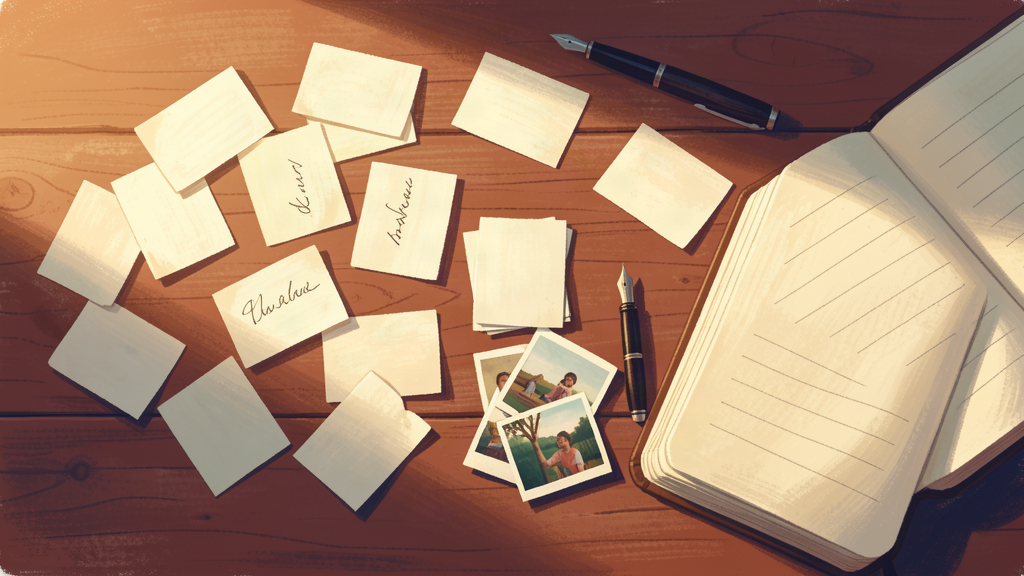
What goes on the wall — and why
Names
One card per person you are actually fighting for. Names, not categories. "My family" is a wish; "Marcos" is a prayer.
Scripture
Two or three verses that speak to what you are carrying right now — not a decorative collection. Change them when the season changes.
Requests, dated
Write what you are asking and the date you started asking. This is the entire reason to write anything down.
Answers, dated
When something moves, write it and date it. Within a year this becomes the most persuasive thing on the wall, especially on the days you do not feel like praying.
One sentence about who God is
Not about your situation. On the hard days, the wall should say something true that has nothing to do with how the week is going.
Now put something on it
Make your first cards — a name, a front, a verse — and print them for the wall.